

The Situation
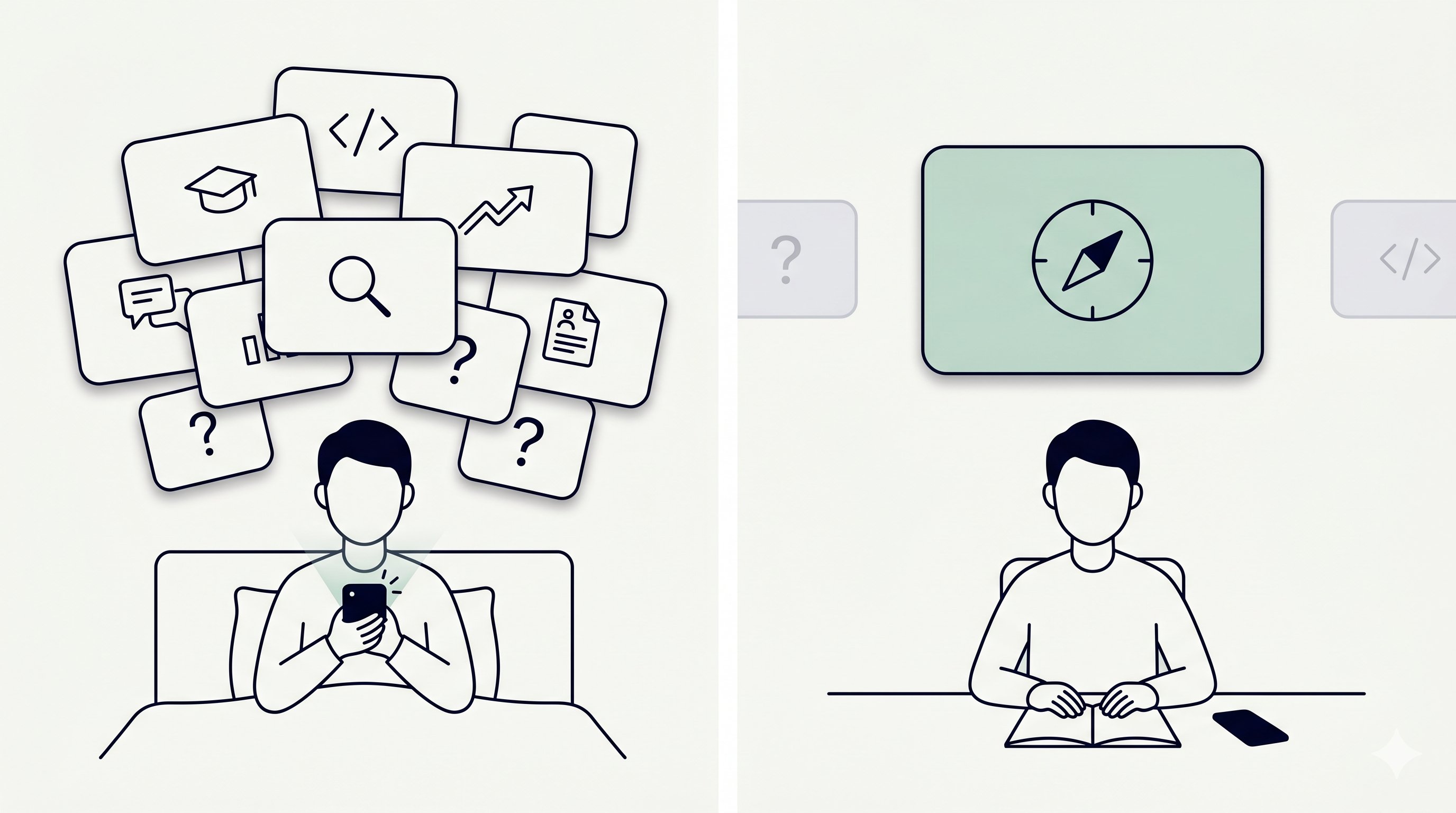
It's 11:47 PM on a Wednesday. You're in bed, but you're not sleeping. You're scrolling.
An article about how GPT-5 can now write better marketing copy than most mid-level managers. A LinkedIn post from someone who "automated 80% of their job" and is now consulting about how to automate yours. A Reddit thread titled "Is anyone else terrified?" with 4,200 upvotes and a comment section that reads like a support group for people who haven't been laid off yet but feel like they're about to be.
You half-open Coursera. There's an AI prompt engineering course you bookmarked three weeks ago. You've bookmarked it four times now. You haven't started it.
You switch to LinkedIn. Update the headline? Add "AI-curious"? You close the app. Open it again. Close it again.
This is a version of what we call the Split-Screen Trap — half of you is doing your job, half of you is doom-scrolling disguised as career planning. Neither half gets your full energy.
This isn't research. This is the scroll spiral — the modern version of pacing the room at 2 AM, except the room is infinite and every wall is a headline telling you the future already happened without you.
And the worst part: you're more exhausted by this nightly ritual than by anything you did at work today.
The Diagnosis: The Minimum Viable Action
Here's what nobody in your LinkedIn feed is telling you: AI isn't your problem. Your problem is that AI made the future feel unknowable, and unknowable futures paralyze decisions.
The Minimum Viable Action (MVA) is a decision-making framework for when you're stuck in research mode instead of action mode — when the smallest possible step that gives you real data is worth more than another month of planning.
The numbers confirm you're not alone in this paralysis. According to a 2026 ADP global survey of over 30,000 workers, only 18% of individual contributors feel their job is secure. Even at the C-suite level, barely a third feel safe. And Gallup's State of the Global Workplace 2026 report found that employee engagement has dropped to just 20% worldwide — its lowest point since 2020 — costing the global economy an estimated $10 trillion annually in lost productivity.
The people most anxious about AI aren't the people most at risk from AI. They're the people most paralyzed by indecision about AI.
When the paralysis comes from an employer directly — like being asked to voluntarily resign with nothing in writing — the move is different, but the principle is the same: force the invisible trap into something concrete.
Everyone's telling you to upskill, learn prompt engineering, "become AI-proof." That advice isn't wrong — it's just not the first move. The first move is deciding what you're building toward. Without that, every AI course is just another open Coursera tab.
Your situation is different
Maybe you're a mid-level manager wondering if your reports will be automated. Maybe you're an IC told to 'integrate AI' with zero guidance.
Those specifics change the move. Get the version written for your exact situation — takes 8 minutes.
Get your custom scriptHere's Your Move
Stop trying to answer "Will AI take my job?" — that question is unknowable and it's keeping you stuck.
Instead, answer this one:
"What would you do next if your role disappeared in 6 months?"
Not "what would you do if you got fired." Not "how would you survive." But: what would you actually choose to do next?
Sit with that question. Write down the answer — even if it's messy, even if it's three different answers. Then do the smallest version of that thing this week. Not the course. Not the career pivot. The smallest version.
If your answer is "I'd go into product management" — message one PM this week and ask what their first month looked like. That's your MVA.
If your answer is "I'd freelance" — send one cold email to someone who needs what you do. Not ten. One.
If your answer is "I honestly don't know" — that's useful too. Write down the three careers you considered in the last six months. Notice which one keeps coming back. That repetition is data.
The goal isn't to have a five-year AI-proof career plan by Friday. The goal is to replace the scroll spiral with one small piece of evidence about what you actually want.
Yeah, But What If I Pick the Wrong Thing?
This is the objection that keeps people stuck for months: "What if I invest time in the wrong direction and AI makes it irrelevant anyway?"
Here's why that fear is overweighted: the MVA isn't a bet. It's a test. Messaging one product manager doesn't commit you to a career in product management. Sending one freelance email doesn't mean you're quitting your job. You're gathering data, not signing a contract.
The risk of one small action is near zero. The risk of another three months of scrolling at 11 PM is real: you'll be in the same bed, with the same open tabs, feeling the same dread — only now it's July and the anxiety has compounded.
The wrong small move teaches you something. The right amount of inaction teaches you nothing.
What Doing Nothing Costs You
- Energy: You're spending more cognitive energy worrying about AI than you'd spend actually making a career decision. The scroll spiral is a full-time job that pays in anxiety.
- Time: Every week you spend "researching" without acting is a week someone else — who is no smarter than you — spent testing, learning, and building a head start.
- Identity: The longer you stay in the decision vacuum, the more "anxious about AI" becomes your identity instead of "person who made a move." That identity is harder to shake than any market shift.
Your Backup Plan
You spend a weekend with the question and the answer is "I genuinely don't know." That's a valid outcome.
"I don't know" with clarity is better than "I don't know" with panic. Now you know what to research — not "everything about AI" (which is what the scroll spiral pretends to be), but the one or two paths that keep pulling at you. The search gets narrower. The tabs get fewer. The 11 PM scroll turns into a 20-minute focused read.
And if the first small action doesn't go well? You got data. The PM you messaged said the role is "mostly meetings and stakeholder management"? Great — now you know that's not for you, and you saved yourself six months of imagining it was.
The MVA is designed to be low-cost and high-information. That's the whole point.
The Reframe
You're not behind. AI didn't leave you behind while you weren't looking. The people posting about automating their jobs are selling courses, not living your life.
What's actually happening is simpler: the ground shifted, and you froze. That's human. That's normal. And it's fixable — not with a masterclass, but with one honest answer to one honest question.
The scroll spiral ends when you stop asking "What's going to happen to my job?" and start asking "What would I choose to do next?"
That's not a career plan. That's a starting point. And a starting point is all you need.
"One clear direction rather than nodding yes to all possible outcomes like most LLM search engines." — Early tester
Facing AI anxiety, a career crossroads, or a decision you keep postponing?
Run your exact situation through Untangle and get your move in 8 minutes. 100% anonymous. No signup.
Get your moveFAQ: AI Career Anxiety and Decision-Making
How do I deal with AI job anxiety?
Reframe the question. Instead of asking 'Will AI take my job?' — which is unknowable — ask 'What would I do next if my role disappeared in 6 months?' The Minimum Viable Action approach says: answer that question, then do the smallest version of your answer this week. Action replaces anxiety. Scrolling compounds it.
Should I learn AI skills to keep my job?
Upskilling is valuable, but it's not the first move. Deciding what you're building toward comes first. Without a direction, every AI course is just another open tab. Once you know your direction, you can evaluate which AI skills actually serve that path — rather than learning everything out of fear.
Is AI actually going to replace my job?
Some roles will change. Some will be augmented. A few will disappear. But the individual answer depends entirely on your specific role, industry, and how your organization adopts AI. According to Gallup's 2026 data, 65% of workers at AI-adopting companies report a positive impact on their productivity. The more useful question is: what do you want your next role to look like, regardless of AI?
What is the Minimum Viable Action for career decisions?
The Minimum Viable Action (MVA) is a decision-making framework from Untangle. Instead of waiting for perfect clarity before acting, you do the smallest possible thing that gives you real data — one conversation, one email, one hour of research on a specific path. The goal is to replace planning paralysis with evidence.
Why am I so anxious about AI even though I haven't been affected yet?
Because uncertainty is more stressful than bad news. Research shows that ambiguity about the future triggers more anxiety than a known negative outcome. The 2026 ADP survey found that even 65% of C-suite executives don't feel fully secure. Your anxiety isn't irrational — it's a normal response to unprecedented uncertainty. The fix isn't reassurance. It's action.