
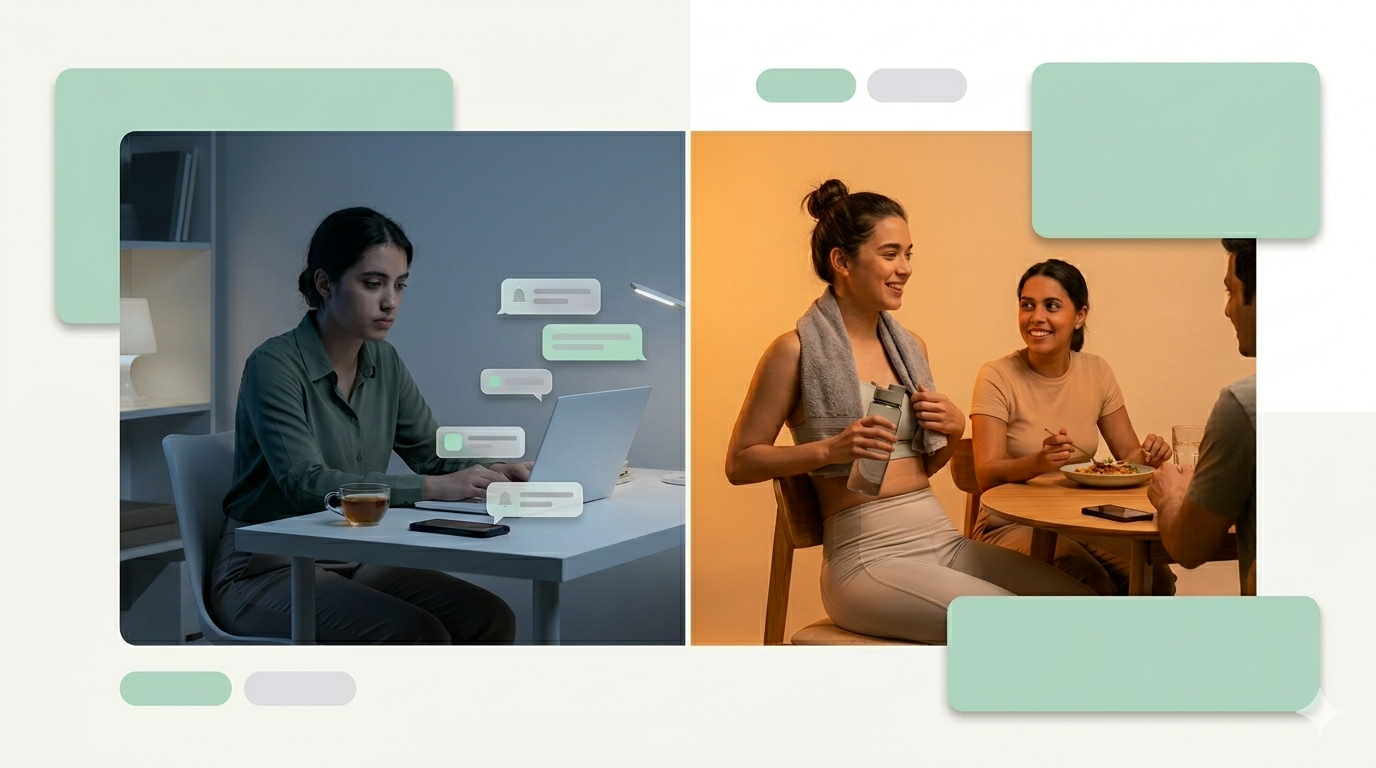
Remote work blurred every boundary. Slack made being always on the default. Hustle culture told you to grind harder, and now "soft life" is trending as the exhausted backlash. Meanwhile, the actual work-life balance advice hasn't changed in twenty years. More people than ever are reporting burnout, decision fatigue, and a quiet crisis of not knowing when to stop. This isn't a time-management problem. It's a trade-off problem.
The Situation
It's 6:15 PM on a Tuesday. Your laptop is open. Your gym bag is staring at you from the corner.
You know you should close the laptop. You know your mental health requires it. But there are three unread Slack messages from your team. The thought of being offline makes your chest tight.
Skip the gym, keep working, order takeout — and go to bed feeling like a barely functional adult. Or go to the gym, spend the entire workout checking your phone between sets, and feel terrified you look "less committed" to your manager.
This is what work-life balance actually feels like for ambitious people: constant guilt either way. Being always on isn't a personality flaw — it's the trap you were handed.
So, you do what high-achievers always do. You enter The Split-Screen Trap.
The Split-Screen Trap: Why Work-Life Balance Fails Ambitious People
You want your career to get 100% of your ambition. And your personal life to get 100% of your presence.
The Split-Screen Trap is the state of trying to be present in two places at once — never fully working, never fully resting — until the split itself becomes the source of exhaustion.
That's not balance. That's a rigged game.
You work from home so you can "have more time," but you keep Slack active during dinner so no one thinks you're slacking off. You're never fully working and you're never actually resting. Every small decision — when to log off, whether to check that message, gym or another hour at the desk — drains you before you've even started the real work. That's decision fatigue, and it compounds daily.
Balance is a myth sold to people who don't have demanding lives. You are treating this like a time-management puzzle, hoping a better calendar app will suddenly create a 26-hour day. It won't. You are in a genuine trade-off — and until you name it, you can't make a real choice.
Your constraints are real
The 60-minute window works for some. But what if you're on-call? Studying for a competitive exam while holding a demanding job?
Your exact constraints change the exact move. Get a personalized escape plan that protects both your boundaries and your reputation — under 5 minutes.
Get your custom scriptYour Constraints Are Real (And Generic Advice Ignores Them)
The standard advice — "just set boundaries" — assumes you have the leverage to enforce them. Most people don't.
Maybe you're on an on-call rotation where being offline isn't a choice. Maybe you're preparing for a competitive exam or a master's degree while holding a demanding full-time job. Maybe your startup is three months from a funding round and disappearing for an hour feels like career suicide.
The 60-minute experiment below is a starting point — but your version of it depends on your exact situation. Get the custom script built for your specific constraints in under 5 minutes.
When the pressure comes from your employer directly — say, being asked to voluntarily resign with nothing in writing — the move looks different, but the principle is the same: force the invisible trap into plain text.
The 60-Minute "Choose the Drop" Experiment
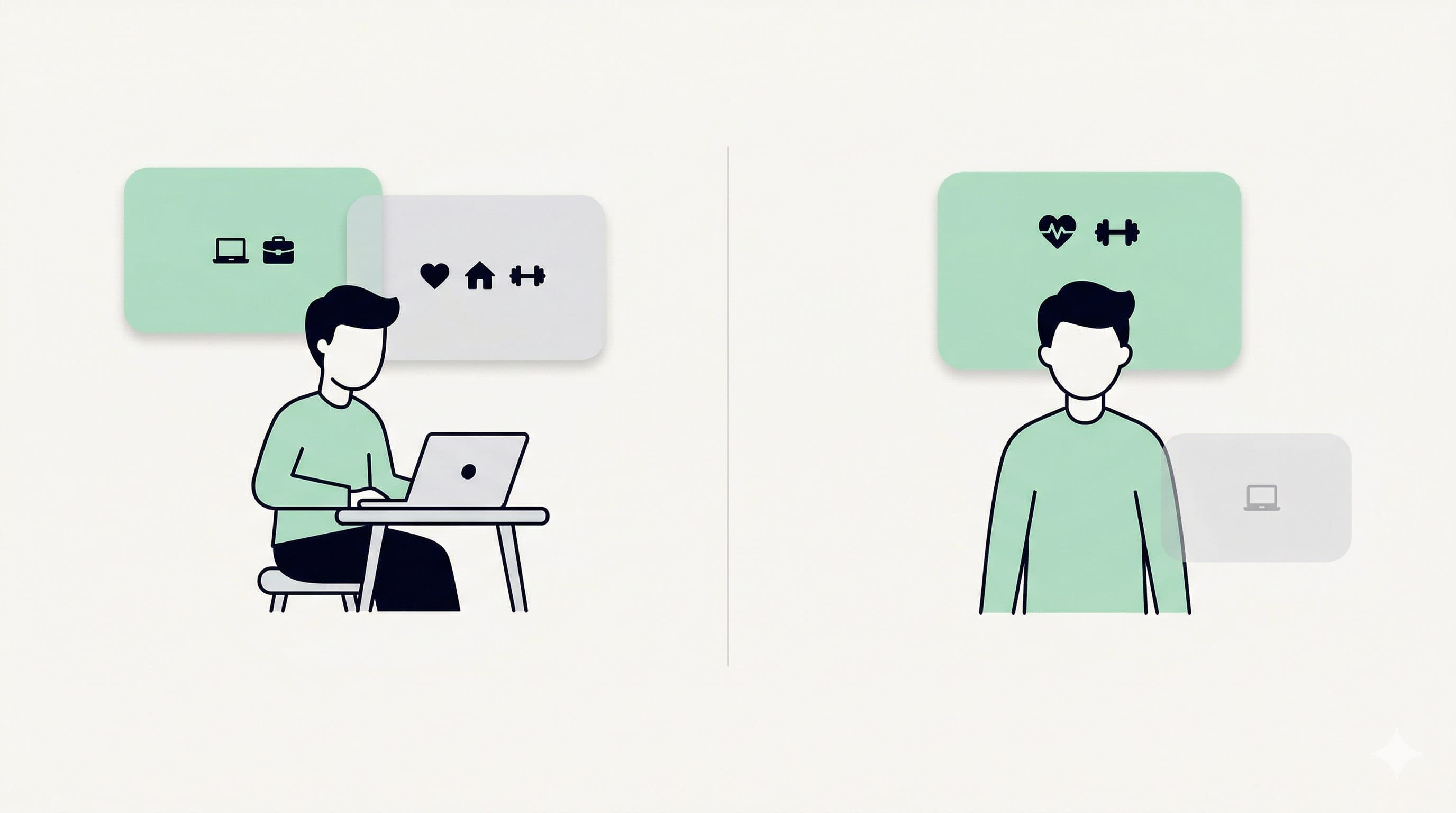
Stop trying to balance the scales. Choose the drop. You cannot keep all the balls in the air, so you have to proactively choose which one hits the floor today.
Choose the Drop means deliberately letting one thing fall today so the other can be done fully — not balance, but intentional imbalance that shifts over time.
Tomorrow, run this experiment:
- Pick one 60-minute window. Treat it like a meeting you cannot miss.
- Choose your activity: a workout, a hobby, dinner with someone you like.
- Phone in another room. Slack ignored. Emails untouched. Non-negotiable.
- Be intentionally unavailable. For those 60 minutes, you are a 'bad employee' on purpose.
The goal isn't the workout. It's training your nervous system to tolerate being offline — so it stops being a terrifying decision and starts being a default.
What Doing Nothing Costs You
If you keep trying to split the difference, here is what you are actually choosing:
- Burnout: The Split-Screen Trap is unsustainable. More people are reporting being tired but wired — exhausted yet unable to switch off — and quietly reconsidering everything. You will crash, and it will happen at the worst possible time.
- Mediocrity: Half-presence at work means half-quality output. Half-presence at home means half-quality relationships. You get the worst of both.
- Resentment: You will start resenting everyone — your job, your family, yourself. Because you never actually chose anything. You just drifted.
The Reframe: From Balance to Strategic Trade-Offs
You are not failing at balance. Balance was always a lie. What you need is not equilibrium — it's intentional imbalance.
Intentional imbalance means choosing what to drop on purpose, instead of dropping everything by accident. It means strategic trade-offs: this week, the gym wins and the late Slack replies lose. Next month, the product launch wins and the social calendar gets lighter.
That's not giving up. That's the only move that actually works.
Turn Your "Yeah, But..." Into a Plan
Untangle's personalization engine has already worked through hundreds of messy, high-stakes decisions — from "Should I go to the office or work from home today?" to "Is it safe to prioritize my health over this promotion?"
Bring your exact "Yeah, but..." — your on-call schedule, your manager's expectations, your specific guilt — and get a personalized escape plan that protects both your boundaries and your reputation.
Drowning in the Split-Screen Trap? Your 'Yeah, but...' is different from everyone else's.
Drop your exact situation into Untangle and get a personalized escape plan that protects your boundaries and your reputation — in under 5 minutes.
Get your moveFAQ: Work-Life Balance and the Split-Screen Trap
Why does work-life balance feel impossible for ambitious people?
Because balance assumes both sides can get equal attention simultaneously. Ambitious people face competing high-stakes demands — a career that requires deep focus and a personal life that requires real presence. The result is the Split-Screen Trap: half-working and half-resting, excelling at neither.
What is the Split-Screen Trap?
The Split-Screen Trap is Untangle's term for trying to be present in two places at once. You keep Slack open during dinner. You check email between gym sets. You're never fully working and never actually resting — and the exhaustion comes from the split itself, not from either task.
What does 'Choose the Drop' mean?
Choose the Drop means deliberately deciding what to deprioritize today so you can be fully present for something else. This week, the gym wins and the late replies lose. Next month, the product launch wins and the social calendar gets lighter. It's not giving up — it's strategic trade-offs.
How do I stop feeling guilty about not working?
The guilt comes from treating time off as stolen time rather than chosen time. The 60-minute experiment in this article trains your nervous system to tolerate being offline — so disconnecting stops feeling dangerous and starts feeling like a default.
What is intentional imbalance?
Intentional imbalance is the alternative to work-life balance. Instead of trying to keep everything equal, you strategically prioritize different areas at different times. This week, health wins. Next month, the career push wins. The key is that the imbalance is chosen, not accidental.